You are the
light of the world
I remember
that book
so well. It
was filled with the most wonderful things.
No other book will ever have the magic and power
of that special “story book” of my childhood.
I remember the soft
blue cover,
and the beautiful colored pictures,
not as bright and shiny as children’s books are now,
but with a beauty for me that none of them can match.
I actually found the
physical
copy of that book after the death of my parents.
I still have it, but the magic and the power are not in that
actual book.
It is the book of my memory which is magical,
not the paper and ink.
It had sections for
fairy tales
and nursery rhymes and fables,
but also stories about real people.
One of those historical
stories was about a young girl,
still in her teens,
a girl named Victoria.
 One
day
some very special visitors came to call upon her.
One
day
some very special visitors came to call upon her.
One of them was the Lord Chamberlain and the other
was
the
Archbishop of Canterbury.
I remember that book and that story today because of that
deeply moving moment when the Lord
Chamberlain says,
“Victoria,
I am grieved to have to tell you
that your uncle,
the King, is dead. But I am
honored to say,
Victoria, you are
now the Queen of England.
What a weight of meaning these simple words carried for her.
She had known since childhood that this day would come,
she
had been carefully prepared for it.
But now, with these
simple
words, all the high privilege,
all the awful responsibility actually rested on her.
The words, “You
are the Queen,”
were truly double edged.
No
wonder her first royal request was to the Archbishop,
“Please, sir, pray now for me.”
A good man may look
into the
eyes of his child and say,
“You are my son,”
and the words will convey all the
honor
and privilege he can possibly convey.
But such words, spoken
by a good
and worthy man, will also convey
the weight of responsibility of being a son worthy of
the man.
It has now been almost
50 years
ago, but I can still feel the heavy hand
of Bishop A. Frank Smith as he laid them upon my
head and said,
“Take thou authority to exercise the
office of elder
in the Church of God.”
Today, we are reminded
of words
even more powerful than those
spoken to young Victoria, with more meaning than
that of
a father to his son, more than that of bishop to minister.
We are reminded today
of words
spoken to each of us,
and to all of us, by the Lord Jesus Christ himself.
To us, to all who are his followers he says
again today,
“You are the light of the world. Let your light shine.”
I want to
emphasize
three little
three-letter words which Jesus used:
You, are, and let.
You: Hear this very personally. Hear
Jesus call
your
name:
You are the light of the world. Hear it also as a
congregation
as the body of Christ in this place:You
are the light of the world
If we hear Jesus
speaking to us
like that, it ought to bring a sense
of amazement, of awe, bordering on unbelief
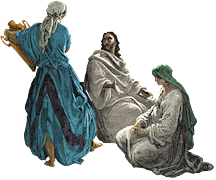 The
disciples who first heard those words must have felt much
The
disciples who first heard those words must have felt much
of that amazement and must have asked
themselves,
“Does he mean me? Does he mean us? How can that be?”
It would be a vast understatement to say that
they were not among
the great and powerful of their time.
No one had ever heard of them outside
of their own families
and in their own villages.
Their names would not have been recognized among the
leaders of the world
such as Pontius Pilate, the Roman Govenor
or Caiphas, the high priest
Yet, isn’t it interesting to note today that except for
the light that those
simple followers of Jesus shone upon the
world,
we would never have heard of Pilate
or Caiphas.
They were simple folk: fishermen, housewives, young
people.
People who were for the most part as
ignorant of the wider world
as the world was ignorant of
them.
But it was to them, to them personally, specifically,
to these plain, ordinary people who had heard
his word of love and trusted in him
that he said, “You are the light
of the world.”
It is just as true of us as it was of them. It is just as
true of them
as it is of us: we are not worthy,
we are not strong enough,
or good enough, or
brave enough.
Still Jesus
says, “You are
the light of the world.”
And that is the second powerful little
word which is so
emphatic, are.
You are.
You are the light of the world.
His words do not begin as a
demand, not as an obligation,
but as a gift.
He does not say, “You ought to be the
light of the world.”
or “You must try to be the light of the
world.”
It
is simply, “You are the light of the
world.”
What is even more amazing is that he is not saying,
“You have
the light of the world” as if that is our message,
but
“You are
the light of the world.”
That
means “you”, in your whole, actual life in the world are
the light
because you know him. His light has shined
though faith into your life
and
now that light shines out in everything you do and
say.
The light is not just the message we have to give to the
world
it is who we are, it is how we live, in the
world.
It is light of Christ translated
through living persons.
The light that people need in the darkness of their
lives
is not advise about light, not a message about
light,
but to see light through people
like themselves,
in
loving words and acts of love.
The light that shines through us is not something we have
to try to do
or try to say, it is just who we are
because of his presence in our lives.
And here we come to the third of our
simple, emphatic words:
let.
Not, “Make your light shine,” not even “Shine
your light.”
just “let your light shine, so they may
see God’s light.”
There is something beautifully confident, even relaxed
about that
which I hope we can receive as a wonderful
gift.
I don’t think
most people want others “shining their
religious light”
on them all the time. I know I don’t. You
probably don’t either.
About the worst thing you can have to happen when you
really need light
is to have someone shine the light right in
your eyes.
Sometimes we do that without thinking, with a flashlight,
trying
to be helpful, but it never helps,
You don’t want the light shined on you, in your eyes.
You want the light to illuminate the path
ahead.
When someone “shines the
light at you” it blinds
rather
than guides.
It draws attention to itself instead of
illuminating the situation.
Instead of that aggressive, “shining” Jesus says,
“Let
your light shine
so people can see your Heavenly Father and
find his way.”
One dark night out in southern New Mexico,
our car had been giving trouble all
afternoon,
and we had just made it to a roadside
park,
where I could make
some repairs.
A summer storm was moving in.
The lightning was streaking the sky to
the west,
and I was struggling with mechanical
matters
which were far beyond
my competence.
Our daughter was a baby and my wife was tired.
We needed to get that car fixed and go on to a
motel for the night.
I was having a hard time.
Then a friendly truck driver came over and brought a very
good flashlight.
“Let me hold the light for you,” he said. And
without making me
look even more stupid, he just held
the light
and gave me some very gentle advise.
That
is the kind
of picture I get from the words of Jesus when he says,
“let your light shine, so people can see.”
We gently and
personally hold the light of Christ
for
everyone around us.
Carl Jung, the
great psychologist
said,

“As far as we can
discover the sole purpose of
human existence
is to kindle a light in the
darkness of mere being.”
Peter Milne was a
missionary who brought the love of
Christ
to the cannibal tribes of the New
Hebrides.
There is a portrait of him in one of their churches,
under which there is this simple tribute
“When
he came, there was no light,
As we come together to his Table of love,
let us all hear him say,
“You,
You are, You are the light of
the world.
Let you light shine, so everyone can
see
God.”